
Quick Answer
According to ASTM F1959/F1959M, ATPV is defined as:Arc Thermal Performance Value (ATPV):”The incident energy on a material or a multilayer system of materials that results in a 50%
probability of second degree burn.”
For example, ATPV = 8 cal/cm² means that under standardized arc testing conditions, when the material is exposed to 8 cal/cm² incident energy, the probability of second-degree skin burn reaches 50%.
ATPV is measured in cal/cm² (calories per square centimeter).
ATPV is used to evaluate the arc thermal protection capability of flame-resistant fabrics or protective clothing systems in arc flash environments. A higher ATPV value indicates a higher level of arc thermal protection.
It is important to understand that ATPV does not simply represent how much energy a fabric can “withstand”. It is a statistical performance value obtained through standardized arc testing.
ATPV testing is based on ASTM F1959/F1959M (North American system) or IEC 61482-1-1 (European CE certification system). These two standards share similar principles but cannot replace each other.
What Is ATPV?
In industries such as electrical maintenance, power generation, and petrochemical processing, workers may be exposed to high levels of thermal energy released during an arc flash event.
The purpose of arc flash protective clothing is not to prevent the arc from occurring, but to reduce the heat transferred to the wearer’s skin after an arc event.
ATPV is the key indicator used to quantify this protection capability.
It answers the question: At what level of arc incident energy will a fabric or protective clothing system reach a 50% probability of second-degree burn under standardized testing conditions?
ATPV is expressed in cal/cm² and represents incident energy density. A higher value indicates higher arc thermal protection performance.
In the industry, ATPV is often described as “how many calories” a fabric has. For example, an “8 cal fabric” means the fabric has an ATPV rating of 8 cal/cm².
How Is ATPV Tested?
ATPV is not calculated directly from fiber composition, fabric weight, or thickness. It is obtained through laboratory arc testing.
The basic testing process includes:
1. Placing fabric samples vertically and exposing them to controlled arc-generated radiant and convective heat.
2. Measuring the heat transferred to the body-facing side through specialized sensors.
3. Testing multiple arc energy levels to evaluate thermal response.
4. Creating a relationship curve between incident energy and burn probability.
5. Comparing the results with the Stoll curve, which defines the thermal energy threshold associated with second-degree burns.
6. Determining the energy value corresponding to a 50% probability of second-degree burn, which becomes the ATPV.
Figure: ATPV logistic regression curve from ASTM F1959 arc flash testing. The curve shows the relationship between incident energy exposure and burn probability used to determine ATPV.
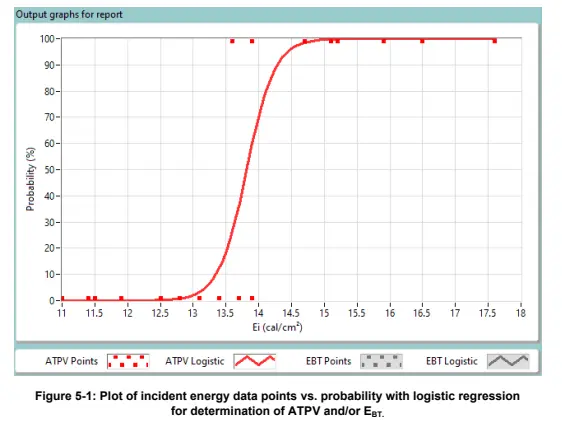
Figure caption:ATPV is determined through laboratory arc testing using incident energy data and statistical analysis. This curve shows the relationship between incident energy exposure and probability used to determine ATPV. Source: ASTM F1959/F1959M-22 ATPV Test Report.
Example of FR Fabric Performance After Arc Exposure
As an example of ASTM F1959/F1959M-22 testing, a 100% FR Cotton Satin fabric with a fabric weight of 350 g/m² was evaluated by Kinectrics laboratory for arc thermal performance. The material achieved an ATPV rating of 14 cal/cm² under the tested conditions.
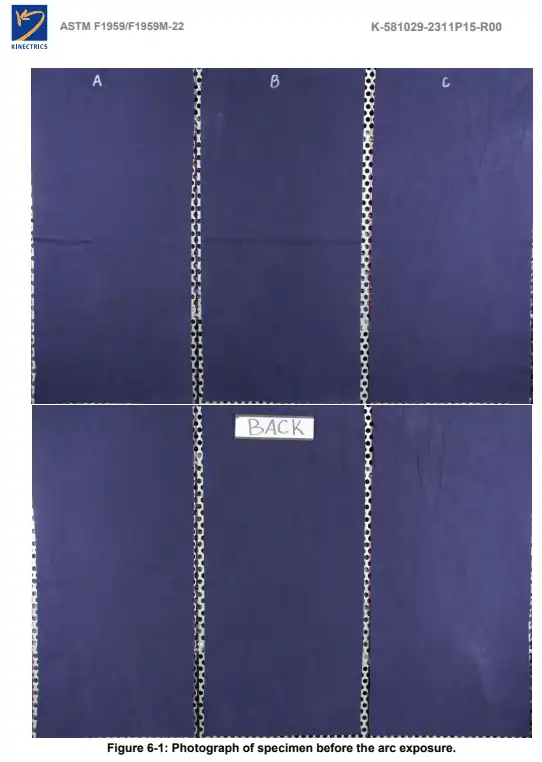
Figure: 100% FR Cotton Satin fabric specimen before ASTM F1959/F1959M-22 arc exposure testing at Kinectrics laboratory. The sample was evaluated for Arc Thermal Performance Value (ATPV) under controlled arc conditions.
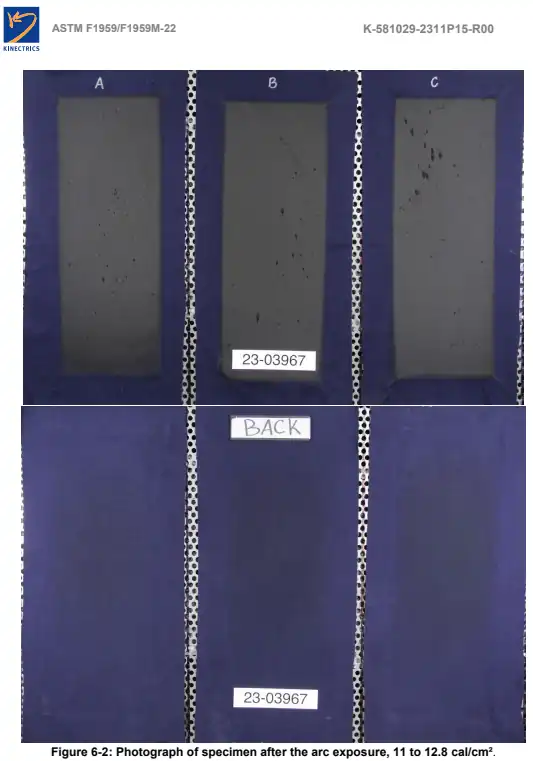
Figure: FR Cotton Satin fabric specimen after exposure to 11–12.8 cal/cm² incident energy during ASTM F1959/F1959M-22 testing at Kinectrics laboratory.
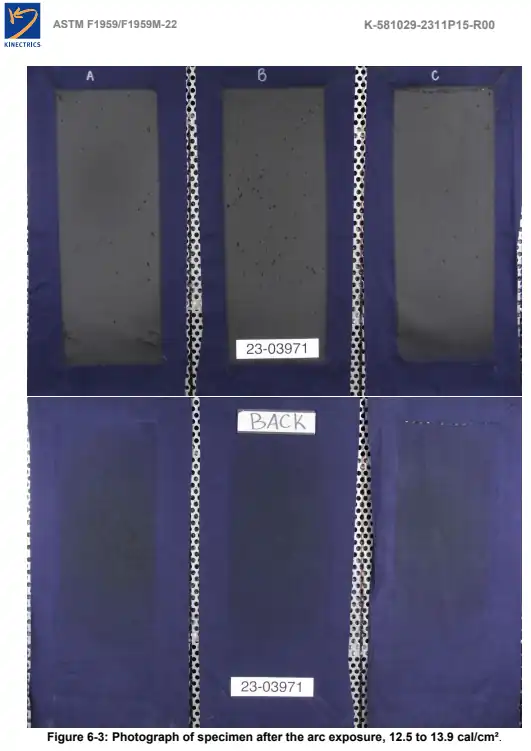
Figure: FR Cotton Satin fabric specimen after exposure to 12.5–13.9 cal/cm² incident energy during ASTM F1959/F1959M-22 testing at Kinectrics laboratory.
ATPV Testing Standards Comparison
Currently, two major open-arc testing standards are widely used for evaluating arc thermal performance: ASTM F1959/F1959M in North America and IEC 61482-1-1 in Europe and other international markets.
ASTM F1959/F1959M
ASTM F1959/F1959M is the primary standard used in the North American market to determine the Arc Rating of flame-resistant materials and material systems.
The test exposes vertically mounted fabric specimens to a controlled open electric arc and measures the heat transferred through the material. Based on the limiting failure mode, the final Arc Rating may be reported as ATPV or EBT.
IEC 61482-1-1
IEC 61482-1-1 applies a similar open-arc testing principle and may report ATPV, EBT, or ELIM values.
The standard includes procedures for evaluating flat materials as well as complete garments or garment combinations.
Although IEC 61482-1-1 and ASTM F1959/F1959M are based on similar testing concepts, their equipment requirements, procedures, and reporting methods are not identical. Therefore, separate test reports are generally required depending on the target market.
| Standard | Main application | Key reporting indicators |
| ASTM F1959/F1959M | North American system | ATPV / EBT |
| IEC 61482-1-1 | European CE certification system | ATPV / EBT / ELIM |
For detailed explanations:
- ASTM F1959 ATPV Test Procedure and Report Interpretation
- IEC 61482-1-1: ELIM, ATPV and EBT Explained
- ASTM F1959 vs IEC 61482-1-1
Difference Between ATPV, EBT, and ELIM
These three indicators commonly appear together in arc testing reports and are often confused.
ATPV (Arc Thermal Performance Value):
The incident energy on a material or a multilayer system of materials that results in a 50% probability of second-degree burn.
EBT (Energy Breakopen Threshold):
The incident energy at which a material breaks open.
ELIM (Incident Energy Limit):
A supplementary indicator specific to IEC 61482-1-1. ELIM represents a more conservative incident energy limit used for arc flash protection risk evaluation.
When both ATPV and EBT values are generated during testing, the final Arc Rating typically uses the lower value.
ATPV vs Arc Rating: Understanding the Difference
In the industry, the term Arc Rating is often used interchangeably with ATPV. However, strictly speaking, Arc Rating is a broader term that includes different arc thermal performance indicators.The final Arc Rating value may be based on either ATPV or EBT, depending on how the material performs during arc testing.
A more accurate explanation is: When both ATPV and EBT values are generated during testing, the final Arc Rating is typically determined by the lower value of the two, rather than assuming that Arc Rating is always equal to ATPV. The final reported Arc Rating depends on the actual performance of the material during the standardized arc test.
HRC vs PPE Category: Understanding the Terminology Change
Before discussing NFPA 70E arc flash PPE categories, it is important to clarify a terminology change.This classification system was previously known as HRC (Hazard Risk Category). However, starting with the 2015 edition of NFPA 70E, the term was officially replaced by PPE Category.Today, PPE Category is the current official terminology used in NFPA 70E for arc flash protective equipment classification.The term HRC is still commonly used in the industry as a historical reference
NFPA 70E classifies arc flash PPE into four categories, and each category has a minimum Arc Rating requirement. An 8 cal/cm² Arc Rating meets the minimum requirement for Category 2. However, a 12 cal/cm² Arc Rating remains Category 2 and does not auto matically become Category 3.PPE Category depends on the required Arc Rating level, not simply the ATPV value.
| Class | Minimum Arc Rating requirement |
| PPE Category 1 | ≥4 cal/cm² |
| PPE Category 2 | ≥8 cal/cm² |
| PPE Category 3 | ≥25 cal/cm² |
| PPE Category 4 | ≥40 cal/cm² |
NFPA 70E and ATPV Selection Logic
The relationship between arc flash risk and ATPV selection follows a clear process:
First, the actual incident energy level of the workplace task must be evaluated based on the specific operating conditions. The required Arc Rating level is then determined according to the calculated hazard level, and protective clothing with an ATPV or Arc Rating meeting the required threshold can be selected accordingly.
It is important to note that for conditions exceeding 40 cal/cm², NFPA 70E does not recommend relying solely on heavier protective clothing as the solution. Instead, energized work should be avoided whenever possible through electrical isolation, de-energization, or engineering controls.
A 40 cal/cm² Arc Rating is generally considered the practical upper limit for clothing-based protection. It should not be interpreted as a direction to continuously increase protection levels simply by selecting higher-rated fabrics.
Single-Layer ATPV Limitations and Multilayer Protection Systems
Single-layer fabrics also have practical limitations when achieving extremely high ATPV ratings.
In industry practice, once protection requirements enter PPE Category 3 (Arc Rating ≥25 cal/cm²), single-layer garments are generally no longer sufficient for many applications. Higher levels of arc flash protection are typically achieved through multilayer protective systems, such as jackets, trousers, and specialized face protection combinations.
In real industrial applications, achieving more than 25 cal/cm² with a single-layer garment is challenging. Higher protection levels are usually achieved through multilayer systems rather than continuously increasing the thickness of a single fabric layer.
This approach is consistent with the principle of air gaps and multilayer insulation discussed earlier: properly designed multilayer systems can often achieve higher protection levels while maintaining better mobility, comfort, and wearability compared with simply increasing single-layer fabric thickness.
ATPV Rating Chart
| ATPV Rating | Typical Application |
| 4 cal/cm² | Basic arc flash protection applications |
| 8 cal/cm² | Common electrical maintenance clothing level |
| 12 cal/cm² | Higher exposure risk environments |
| 25 cal/cm² | High-risk arc flash applications |
| 40 cal/cm² and above | Advanced protective clothing range |
Actual requirements should be determined through arc flash risk assessment rather than selecting fabrics only by ATPV value.
Factors Affecting ATPV Performance
Fiber composition, fabric color, fabric weight, construction, moisture, layering systems, base-layer materials, washing, and aging conditions can all affect ATPV results.
Even fabrics with the same GSM may show different ATPV results because of differences in thermal decomposition behavior, char formation capability, fabric structure, and heat transfer pathways.
For a more detailed explanation of how fiber composition, color, fabric weight, construction, moisture, layering, laundering, and other variables influence arc ratings, see our guide to the factors affecting ATPV performance of FR fabrics.
The detailed article includes Safe-Guard test observations and practical considerations for fabric development and ATPV testing.
How to Choose ATPV Flame Resistant Fabrics
When selecting ATPV-rated flame-resistant fabrics, consider:
– Required Arc Rating level
– Workplace risk
– Applicable standards
– Fabric comfort
– Fabric weight
– Durability
– Certification requirements
The highest ATPV value does not always represent the best solution. The correct choice should be based on actual application requirements.
Cotton FR Fabric:
Provides good comfort and moisture absorption for long-term wear.
CVC FR Fabric:
Combines cotton comfort and synthetic fiber properties for balanced performance.
Cotton Nylon FR Fabric:
Typically provides higher strength and abrasion resistance.
The final choice should take into account ATPV, application environment and certification requirements. For more information about us, please refer to our: Flame retardant Fabric Purchase Guide
Frequently Asked Questions (FAQ)
Q1: What ATPV value is considered qualified?
A1: There is no universal ATPV pass/fail value. Requirements should be determined according to the PPE Category and minimum Arc Rating required for the specific application.
Q2: Is a higher ATPV value always better?
A2: Generally, higher ATPV provides higher protection. However, higher ATPV may also increase fabric weight and reduce breathability and comfort.
Q3: What is the difference between ATPV and Arc Flash Incident Energy?
A3: Arc Flash Incident Energy refers to the thermal energy exposure generated during an actual arc event. ATPV refers to the tested thermal protection capability of a material or protective clothing system.
Q4: Can the same fabric have different ATPV results in different laboratories?
A4: Yes. Arc testing has inherent measurement uncertainty, and standards allow conservative evaluation based on test results.
Q5: Are ATPV and arc flash clothing service life the same concept?
A5: No. ATPV reflects the test result of a nearly new material under laboratory conditions. Actual performance can be affected by washing, aging, sunlight exposure, wear, and maintenance.
Q6: Does higher GSM always mean higher ATPV?
A6: No. Fiber properties, fabric construction, and heat transfer behavior all influence ATPV.
Q7: Is ATPV the same as flame resistance?
A7: No. Flame resistance evaluates burning behavior, while ATPV evaluates arc thermal protection.
Q8: Does washing affect ATPV?
A8: Long-term washing, wear, and chemical exposure may affect protective performance.
Q9: Does ATPV testing represent the entire lifetime of protective clothing?
A9: No. ATPV represents laboratory-tested material performance. Actual service life also depends on washing frequency, wear level, and maintenance practices.