
Cotton FR Fabric
Cotton FR fabric is a treated flame retardant fabric designed for industrial workwear, protective clothing, welding garments and safety uniforms. It is widely used in work environments where workers need flame protection, breathable comfort and reliable daily wear performance.
SAFE-GUARD offers cotton-based FR fabric options, including 100% cotton FR fabric and cotton anti-static FR fabric. Fabric weight, color, hand feel, width, finishing requirements and standard testing options can be discussed according to the final garment application and target market.
Whether your project requires lightweight cotton FR fabric for daily uniforms, heavyweight cotton FR fabric for welding clothing, or cotton anti-static FR fabric for oil and gas workwear, this page helps you choose the right cotton flame retardant fabric for your application.
Cotton FR Fabric Products
SAFE-GUARD supplies cotton FR fabric products in different weights, compositions and application directions. Product specifications can be selected according to garment use, protection level, comfort requirements and standard testing needs.
Recommended product title format:
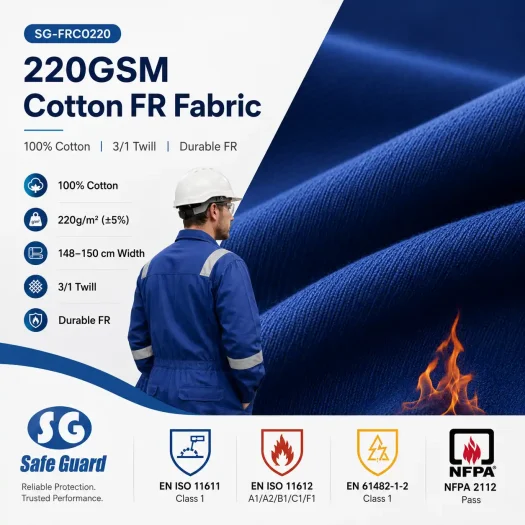
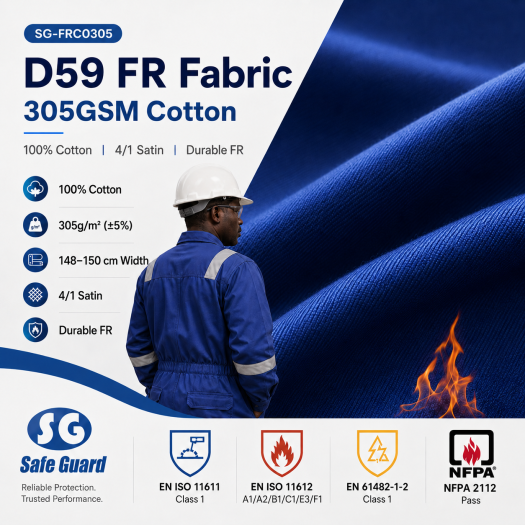
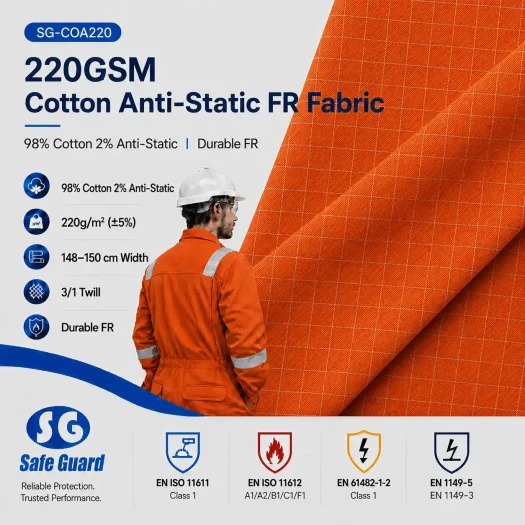
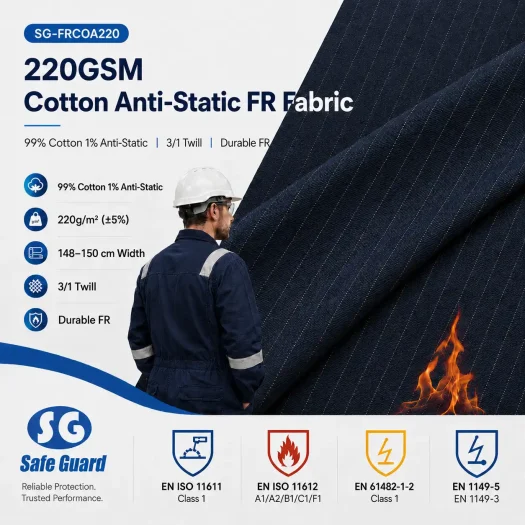
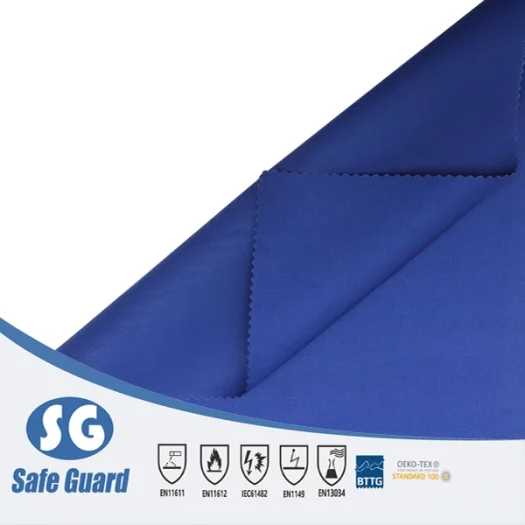
For each cotton FR fabric product, buyers can request details such as composition, GSM, width, color, shrinkage control, washing performance, standard testing options and sample availability.
Designed for Comfortable Flame Protection
For workwear projects where comfort and breathability are important, cotton FR fabric is often one of the preferred choices. Compared with many inherent FR fabrics such as aramid or modacrylic blends, 100% cotton flame retardant fabric offers a more natural hand feel, better moisture absorption and comfortable daily wear performance.
Cotton FR fabric is especially suitable for workers who need to wear protective garments for long hours. Its cotton base helps improve breathability and skin comfort, while the flame-retardant treatment helps the fabric meet protective clothing requirements for industrial use.
For warmer climates or lighter protective uniforms, lower GSM cotton FR fabrics can be considered to improve comfort. For welding, foundry or heavy-duty industrial workwear, higher GSM cotton FR fabrics are often selected for stronger fabric density and more demanding working conditions.
Cotton FR Fabric Options
SAFE-GUARD cotton FR fabric products include standard 100% cotton flame retardant fabric and cotton anti-static FR fabric options. Different fabric structures can be selected according to comfort, flame protection, static-control performance, garment type and end-use environment.
100% Cotton FR Fabric
100% cotton FR fabric is made with cotton base fabric and treated with flame-retardant finishing. It is commonly used for welding clothing, foundry workwear, industrial protective clothing and general flame retardant uniforms.
This fabric type is selected when buyers need a balance of comfort, breathability and flame protection. It can be developed in different GSM ranges, colors and finishing requirements according to garment production needs.
Common uses include:
- Welding clothing
- Foundry workwear
- Industrial workwear
- Flame retardant uniforms
- Protective shirts, trousers, jackets and coveralls
- General industrial protective clothing
Cotton Anti-Static FR Fabric Options
For oil, gas, chemical, petrochemical and other static-sensitive work environments, SAFE-GUARD provides cotton anti-static FR fabric options for workwear and protective clothing projects that require both flame protection and static-control performance.
In practical fabric production, 1% and 2% anti-static specifications are often used to distinguish conductive thread layout and fabric structure. Conductive threads can be woven in the weft direction or in both warp and weft directions according to customer requirements. Since conductive threads are inserted at controlled intervals rather than blended evenly like regular fibers, the actual physical content of conductive threads is usually far below 1% of the finished fabric.
The key difference is not only the nominal percentage, but also the conductive thread layout, spacing, direction and required anti-static performance.
| Cotton Anti-Static FR Fabric Type | Composition & Tech | Suitable Applications & Environments |
|---|---|---|
| 99/1 Cotton Anti-Static FR Fabric | 99% Cotton / 1% Anti-Static Fiber | General industrial workwear, utility uniforms, and static-control protective clothing. |
| 98/2 Cotton Anti-Static FR Fabric | 98% Cotton / 2% Anti-Static Fiber | Oil & gas workwear, chemical workwear, petrochemical uniforms, and higher static-control environments requiring enhanced protection. |
Conductive thread options may include carbon-based or metal-based conductive filaments, depending on the required static-control level, working temperature and end-use environment. Testing requirements such as EN 1149 can be discussed based on the target market and final garment application.
Cotton FR Fabric Specification Overview
Cotton FR fabric specifications should be selected according to the garment type, working environment, comfort requirements and target standards. SAFE-GUARD can support different cotton FR fabric structures for workwear, protective uniforms, welding garments and static-control applications.
| Specification Item | Available Options / Technical Notes |
|---|---|
| Fabric Type | 100% Cotton FR Fabric; Cotton Anti-Static FR Fabric |
| Composition | 100% Cotton; 99% Cotton / 1% Anti-Static Fiber; 98% Cotton / 2% Anti-Static Fiber |
| Weight Range | Common options include 220GSM, 260GSM, 280GSM, 305GSM and heavier cotton FR fabric options. |
| Application | Workwear, welding clothing, industrial uniforms, oil & gas workwear, chemical workwear and protective garments. |
| FR Treatment Type | Treated flame-retardant finishing |
| Color Options | Navy, orange, yellow, khaki, grey and custom colors according to project needs. |
| Functional Options | Anti-static, water repellent, oil resistant, acid and alkali resistance, depending on project requirements. |
| Standard Options | EN ISO 11612, EN ISO 11611, NFPA 2112, NFPA 70E, IEC 61482, EN 1149 |
| Washing Performance | Washing performance can be developed according to fabric type, finishing process and testing requirements. |
| Bulk Production | Sample development and bulk order support can be discussed based on fabric specification and quantity. |
Standard, washing and multifunctional finishing requirements should be confirmed before sampling and bulk production. Not every cotton FR fabric is designed for every standard or finishing function, so the final specification should be matched to the target garment application.
Cotton FR Fabric by Application
Different work environments require different cotton FR fabric specifications. Fabric weight, density, anti-static structure and standard testing requirements should be selected according to the final protective clothing application.
| Application Scene | Recommended Cotton FR Fabric Specification |
|---|---|
| Welding Clothing | Heavyweight 100% cotton FR fabric, such as 305GSM or higher. |
| Foundry Workwear | 100% cotton FR fabric with higher fabric density. |
| Industrial Workwear | Medium-weight cotton FR fabric, such as 260–280GSM. |
| Summer Workwear | Lightweight cotton FR fabric, such as 220–240GSM. |
| Oil & Gas Workwear | Cotton anti-static FR fabric. |
| Chemical Workwear | Cotton anti-static FR fabric with required static-control performance. |
| Protective Uniforms | Cotton FR fabric selected by GSM, color, hand feel and standard requirements. |
For welding and metal work, heavier cotton FR fabrics are often preferred because they provide a denser fabric structure. For daily industrial uniforms, medium-weight cotton FR fabrics may offer a better balance of protection, durability and comfort. For oil, gas or chemical workwear, cotton anti-static FR fabric can be considered when static-control performance is required together with flame protection.
Cotton FR Fabric GSM Selection Guide
GSM is an important factor when choosing cotton FR fabric. It affects fabric weight, comfort, breathability, durability and the final garment application. The right GSM should be selected based on climate, working intensity, protection level and garment design.
| GSM Range | Common Use (Applications) | Selection Note |
|---|---|---|
| 220–240 GSM | Lightweight FR workwear, warmer climates. | Better breathability and comfort for daily wear. |
| 260–280 GSM | Industrial uniforms, general protective clothing. | Balanced comfort, durability and protection. |
| 305 GSM | Welding, foundry, metal work, heavy-duty workwear. | Higher fabric density for more demanding work environments. |
| 350 GSM+ | Heavy industrial protective clothing. | Suitable for projects requiring stronger fabric weight and durability. |
Lower GSM cotton FR fabric is often selected for lighter uniforms and warmer working conditions. Medium GSM fabrics are suitable for general industrial workwear. Higher GSM fabrics are commonly used for welding, foundry, metal work and heavy-duty protective clothing where stronger fabric density is required.
The final GSM should also consider garment design, expected washing conditions, required testing standards and the working environment.
Standards and Testing Options
Cotton FR fabric can be developed and tested according to different protective clothing requirements. The required standards usually depend on the target market, garment type, industry and final work environment.
Common standard options may include:
| Standard | Protection Focus | Common Application |
|---|---|---|
| EN ISO 11612 | Protection against heat and flame | Industrial protective clothing |
| EN ISO 11611 | Protection for welding and allied processes | Welding clothing and protective garments |
| NFPA 2112 | Flash fire protection | Oil, gas and petrochemical workwear |
| NFPA 70E | Electrical safety and arc flash protection | Electrical and utility workwear |
| IEC 61482 | Arc flash protective clothing testing | Arc-rated garments |
| EN 1149 | Anti-static protective clothing | Oil, gas, chemical and ESD environments |
Standard requirements should be confirmed before sampling and bulk production. Not every cotton FR fabric is designed for every standard, so the fabric composition, GSM, finishing process and testing direction should be matched to the final garment application.
For cotton anti-static FR fabric, EN 1149 testing requirements can be discussed according to the target market and static-control performance needs. For welding applications, EN ISO 11611 may be considered. For heat and flame protection, EN ISO 11612 is often one of the key standards buyers need to review.
Cotton FR Fabric Performance Control
Cotton FR fabric performance depends not only on fiber composition, but also on yarn selection, fabric construction, finishing process, shrinkage control and quality inspection. SAFE-GUARD supports cotton FR fabric development with attention to fabric stability, protective performance and garment production requirements.
Residual Shrinkage Management
Shrinkage control is important for workwear and protective garments because unstable fabric size can affect cutting, sewing and final garment fit. Cotton FR fabric can be developed with shrinkage control requirements according to customer needs and testing conditions.
For projects with strict garment production requirements, residual shrinkage targets should be confirmed before bulk production.
Mechanical Strength and Tear Resistance
Cotton FR fabric used for industrial workwear should provide suitable fabric strength for daily wear, washing and working movement. Fabric density, yarn structure, GSM and finishing process can all affect tear resistance and durability.
For heavy-duty workwear, welding clothing and foundry applications, higher GSM cotton FR fabric is often selected to support stronger fabric density and more demanding use conditions.
Washing Durability
Washing durability is a key concern for flame retardant workwear. Washing performance can be developed for 50–100 industrial wash cycles depending on fabric type, finishing process and testing requirements.
The final washing performance should be confirmed through testing based on the target standard, fabric specification and garment application.
Low-Formaldehyde and Safety Control
For workwear fabrics that contact the skin for long hours, finishing safety and wearing comfort are important. Low-formaldehyde finishing requirements can be discussed according to target market and customer testing requirements.
If the project requires specific chemical safety limits, testing requirements should be confirmed before production.
Multi-Function Finishing Options
Cotton FR fabric can be developed with additional finishing functions according to the working environment and garment use.
Available functional options may include:
- Flame retardant finishing
- Anti-static performance
- Water repellent finishing
- Oil resistant finishing
- Acid and alkali resistance
- Shrinkage control
- Soft hand feel adjustment
Functional requirements should be confirmed before sample development because different finishing combinations may affect fabric hand feel, washing performance, weight and testing direction.
How to Choose the Right Cotton FR Fabric
Choosing the right cotton FR fabric depends on the working environment, garment type, comfort requirements and protection level.
- Need better breathability for daily workwear? Choose lightweight or medium-weight cotton FR fabric.
- Need welding or metal work protection? Choose heavier GSM cotton FR fabric.
- Need oil, gas or chemical workwear? Choose cotton anti-static FR fabric.
- Need stronger abrasion resistance? Consider Cotton Nylon FR Fabric for more demanding durability requirements.
- Need custom color, GSM or standard testing? Confirm your fabric requirements before sampling.
For projects where cotton comfort is important but stronger tear strength and abrasion resistance are required, Cotton Nylon FR Fabric may be a better choice. Cotton FR fabric is more suitable when comfort, breathability and natural hand feel are the main priorities.
Custom Cotton FR Fabric Support
SAFE-GUARD supports cotton FR fabric customization based on garment production needs and end-use requirements. Buyers can discuss fabric specifications before sampling and bulk production.
Sample-Based Cotton FR Fabric Matching
For buyers who already have a target fabric sample, SAFE-GUARD can support sample-based cotton FR fabric matching. Instead of simply offering stock fabric, we can review the customer’s sample requirements and develop cotton FR fabric based on composition, GSM, yarn structure, fabric density, hand feel, color and functional requirements.
This process helps closely match the customer’s target sample in fabric structure, hand feel, color and performance requirements.
Custom Specification Support
Customization options may include:
- Custom GSM
- Custom color
- Fabric width
- Hand feel adjustment
- Shrinkage control
- FR dyeing and finishing
- Anti-static conductive thread layout
- Weft-direction conductive thread configuration
- Warp and weft conductive thread configuration
- Water repellent finishing
- Oil resistant finishing
- Acid and alkali resistance
- Sample development
- Bulk production support
- Standard testing support
For cotton anti-static FR fabric, conductive thread layout can be adjusted according to static-control requirements, garment use and target testing standards. For 100% cotton FR fabric, GSM, color, hand feel and shrinkage control are often the key factors buyers need to confirm before production.
From Sample Development to Bulk Production
After the target specification is confirmed, SAFE-GUARD can support sample development and bulk production according to the customer’s garment manufacturing needs. Before production, buyers should confirm composition, GSM, color, width, standard testing requirements, washing performance expectations and finishing functions.
This helps reduce risks during garment production and ensures the cotton FR fabric is better matched to the final protective clothing application.
FAQ
What is cotton FR fabric?
Cotton FR fabric is cotton-based flame retardant fabric used for protective workwear, welding clothing, industrial uniforms and safety garments. It is usually treated with flame-retardant finishing to help reduce flame spread and support protective clothing requirements.
Is cotton FR fabric comfortable for workwear?
Yes. Cotton FR fabric is often selected for workwear because it offers natural cotton comfort, breathability, moisture absorption and a softer hand feel compared with many synthetic-heavy FR fabrics.
What GSM is suitable for welding clothing?
Welding clothing often requires heavier cotton FR fabric. 305GSM or higher cotton FR fabric can be considered for welding, foundry, metal work and other more demanding work environments. The final choice should depend on garment design, working conditions and standard requirements.
What is the difference between 100% cotton FR fabric and cotton anti-static FR fabric?
100% cotton FR fabric focuses on cotton comfort and flame-retardant performance. Cotton anti-static FR fabric adds conductive threads or anti-static fiber configuration to support static-control performance for oil, gas, chemical, petrochemical or ESD-related work environments.
What is the difference between 99/1 and 98/2 cotton anti-static FR fabric?
99/1 and 98/2 cotton anti-static FR fabric are commonly used to distinguish different anti-static specifications and conductive thread configurations. In actual woven fabric structure, conductive threads are usually inserted at controlled intervals, so the physical content of conductive threads is usually far below 1% of the finished fabric.
Can cotton FR fabric meet EN ISO 11612 or NFPA 2112?
Cotton FR fabric can be developed and tested according to different protective clothing standards, including EN ISO 11612 and NFPA 2112, depending on the fabric specification and application requirements. Testing requirements should be confirmed before sampling and bulk production.
Can cotton FR fabric be customized by GSM and color?
Yes. Cotton FR fabric can be customized by GSM, color, width, hand feel, shrinkage control, finishing process and standard testing requirements. Buyers can provide target specifications or garment application details for fabric recommendation.
Can cotton anti-static FR fabric be used for oil and gas workwear?
Yes. Cotton anti-static FR fabric can be considered for oil and gas workwear when flame protection and static-control performance are required together. The final fabric structure, conductive thread layout and testing requirements should be confirmed according to the target garment application.
Request Cotton FR Fabric Samples or Bulk Pricing
Tell us your required composition, GSM, color, application and standard requirements. SAFE-GUARD can help recommend suitable cotton FR fabric options and provide sample, technical data or bulk pricing support based on your project needs.
Request a Quote
Ready to Work Together? Build a project with us!